Product selection guide
3D print ideas to sell, ranked by profit per printer hour
A printer can only run so many hours a week. The question is not "which product makes the most per sale" but "which product makes the most of the hours I have". Here is how to measure that, using twelve example products.
Published 11 November 2026 · by Spool & Margin · about 7 minutes
The one number
Profit per sale is what is left of the price after the true cost (material, machine wear, electricity, labor, failure allowance, packaging) and the selling fees. If you have not worked that out yet, start with How to price 3D prints or the calculator, which shows profit per printer hour for any single product.
Print hours per item is the slicer time for one item. If you fill a plate, it is the plate time divided by the number of items on it:
Twelve products, ranked
Same shop, same labor rate ($20 per hour), same target margin (40%), same fee settings (9.5% + $0.25 per order + $0.20 per item), three printers. Sorted from best to worst use of printer time:
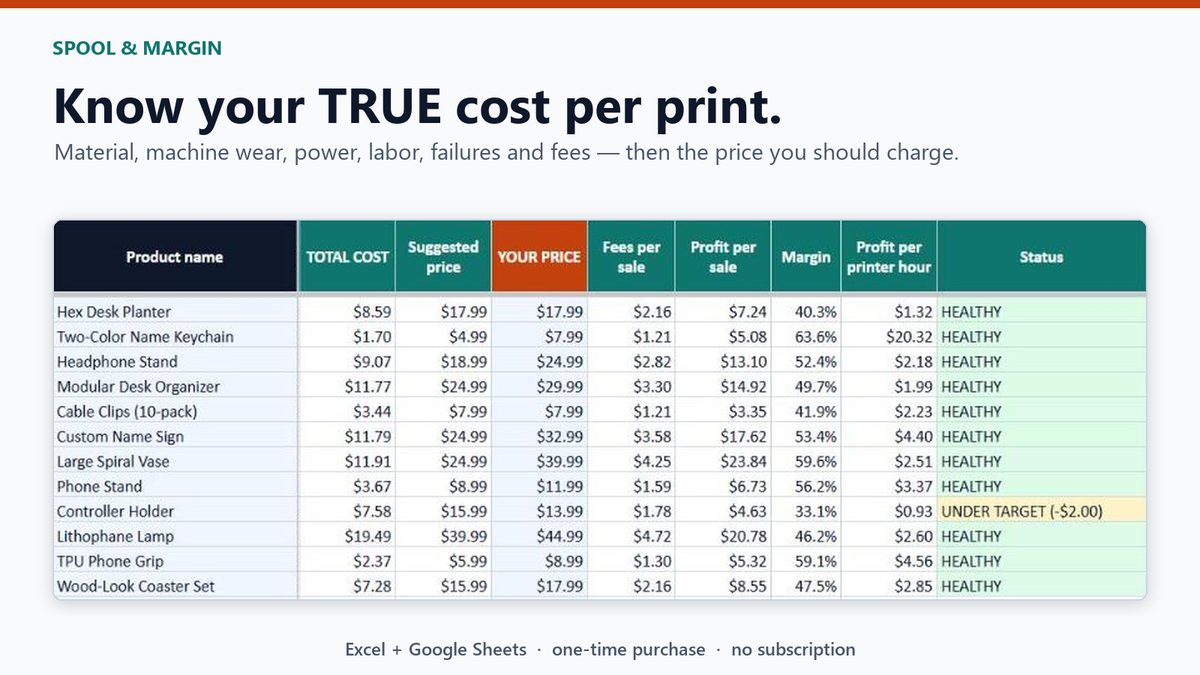
| Product | Print hours per item | Price | Total cost | Profit per sale | Margin | Profit per printer hour |
|---|---|---|---|---|---|---|
| Two-color name keychain (12 per plate) | 0.25 | $7.99 | $1.70 | $5.08 | 63.6% | $20.32 |
| TPU phone grip (6 per plate) | 1.17 | $8.99 | $2.37 | $5.32 | 59.1% | $4.56 |
| Custom name sign | 4.00 | $32.99 | $11.79 | $17.62 | 53.4% | $4.40 |
| Phone stand | 2.00 | $11.99 | $3.67 | $6.73 | 56.2% | $3.37 |
| Wood-look coaster set | 3.00 | $17.99 | $7.28 | $8.55 | 47.5% | $2.85 |
| Lithophane lamp | 8.00 | $44.99 | $19.49 | $20.78 | 46.2% | $2.60 |
| Large spiral vase | 9.50 | $39.99 | $11.91 | $23.84 | 59.6% | $2.51 |
| Cable clips (10-pack) | 1.50 | $7.99 | $3.44 | $3.35 | 41.9% | $2.23 |
| Headphone stand | 6.00 | $24.99 | $9.07 | $13.10 | 52.4% | $2.18 |
| Modular desk organizer | 7.50 | $29.99 | $11.77 | $14.92 | 49.7% | $1.99 |
| Hex desk planter | 5.50 | $17.99 | $8.59 | $7.24 | 40.3% | $1.32 |
| Controller holder | 5.00 | $13.99 | $7.58 | $4.63 | 33.1% | $0.93 |
The costs here are a little higher than for similarly named products in the free calculator, because the full system also charges a maintenance amount per printer hour and uses a different printer for some products.
What the ranking shows
The biggest profit per sale is not the best product
The large spiral vase earns $23.84 a sale, more than anything else on the list, and has a 59.6% margin. It also holds a printer for nine and a half hours. Per hour it earns $2.51 and sits seventh of twelve.
The keychain is priced at $7.99, the lowest price in the shop, and earns $5.08 a sale. Twelve fit on a plate that prints in three hours, so each one costs a quarter of an hour of printer time. Per hour: $20.32.
Put a number on it. Twenty-four hours of one printer making vases yields about two and a half vases and $60 of profit. The same twenty-four hours of keychains yields 96 keychains and $488, if you can sell 96 keychains. That condition matters, and we come back to it below.
A healthy margin can still be slow money
The hex desk planter reaches its 40% target margin, so on a margin check it passes. It earns $7.24 over five and a half hours: $1.32 per hour. In the same five and a half hours the printer could make 2.75 phone stands and earn $18.51. Margin tells you whether the price is right for the cost. It says nothing about how long the product blocks the machine.
The weakest product is weak twice
The controller holder is the only item under target (33.1%), and it is also last per hour at $0.93. Raising it to the suggested $15.99 would fix the margin, yet it would still be near the bottom of this table. A product like this is a candidate for a redesign or for removal, not just a price change.
Personalization is paid for without extra print time
The custom name sign ranks third at $4.40 per hour even though it needs four hours of printing and 20 minutes of hands-on work, the second-highest labor in the table. The price a personalized item can carry ($32.99 in this sample) is what puts it there. Its labor is already inside the cost, so the per-hour figure is a fair one.
What pushes profit per printer hour up
You can read these straight from the formula. Either the profit per sale goes up, or the hours per item go down.
- More items per plate. Small parts that tile across the bed share one start, one removal and one stretch of unattended time. This is the single biggest lever in the table above.
- Shorter prints. Thicker layers, a wider nozzle, less infill, fewer walls, or a design change that removes supports. Test that the part is still good enough to sell.
- A higher price for the same print. Personalization, sets and bundles, better photos, a nicer material. The printer does not care what the item sells for.
- Less hands-on time. Labor does not use printer hours, but it comes straight out of profit per sale. Designs that need no support removal or assembly earn more per hour of both kinds.
- Lower cost per item. Material and packaging savings help, though for most products in this table they move the result less than plate count or price.
Where the number misleads
- Demand comes first. A product earns its per-hour figure only for the units that actually sell. $20 per hour on an item you sell five times a month is worth less than $3 per hour on one you sell every day. Use the ranking to choose between products that you can already sell.
- It assumes the printer is the bottleneck. If your machines are idle half the week, printer time is not scarce, and any job with a positive profit is worth running. The ranking starts to matter when you have a queue.
- Plate maths needs full plates. Twelve keychains per plate only gives a quarter-hour each if you print, and sell, all twelve. For made-to-order items, be honest about how many usually go on a plate.
- Your own time can be the real limit. If you spend the evening removing supports, calculate profit per hour of your labor as well and look at both numbers.
- Overnight capacity is different. A nine-hour vase fits an overnight slot that short prints cannot fill without someone to swap plates. A long, well-paid print is a good use of hours when nobody is there.
- It is not a price. Profit per printer hour ranks products. It does not tell you what to charge per hour of printing. That is a different calculation, covered in how much to charge for 3D printing per hour.
Most sold is not most profitable
The sample file also tracks units sold. In it, the cable clips are the best seller with 41 units and have earned $128.86 in total. The headphone stand sold 26 units and earned $337.61, the most in the shop. A list sorted by order count would put the clips first. Sorting by profit earned, and then by profit per printer hour, gives a different and more useful picture of where the hours should go.
How to do this for your shop
- List every product with its price, grams, print time (or plate time and items per plate), hands-on minutes and packaging.
- Calculate the true cost and profit per sale for each one.
- Divide profit per sale by print hours per item.
- Sort. Look at the bottom three first: can each be batched, shortened or repriced? If not, consider retiring it.
- When the printers are busy, schedule from the top of the list. Give long prints the unattended hours.
- Repeat when prices, filament costs or fees change.
The full system · $14, one-time
Run the whole shop: orders, filament stock, profit per printer hour
The table on this page is the Products sheet of the full system. It calculates profit per printer hour for every product, handles plate printing and multiple printers, and tracks orders, filament stock and failed prints. Excel and Google Sheets, one-time purchase.
See the full system$14, one-time · Opens on Gumroad · Instant download
Free spreadsheet
Check up to 10 products at once
Not ready for the full system? The free price checker gives the true cost, suggested price, profit, margin and a verdict for ten products.
Download the free checkerExcel + Google Sheets · Free on Gumroad, enter 0
Questions
How do you calculate profit per printer hour?
Profit per printer hour = profit per sale ÷ print hours per item. Profit per sale is the price minus the true cost minus selling fees. If you print several items on one plate, print hours per item is the plate time divided by the number of items on the plate.
What kinds of 3D prints are most profitable to sell?
In cost terms, products that earn a lot for each hour they occupy the printer: small items that can be printed many to a plate, personalized items that sell for more without printing longer, and short prints with little hands-on work. Whether a specific product sells is a separate question that only your own market can answer.
Is profit per printer hour always the right way to rank products?
It is the right measure when printer time is your bottleneck, meaning your printers are busy and you could sell more than you can make. If a printer would otherwise sit idle, any job with a positive profit is worth running.
Before selling a model you did not design, check that its license allows commercial use. This page describes a calculation method, not tax or financial advice.